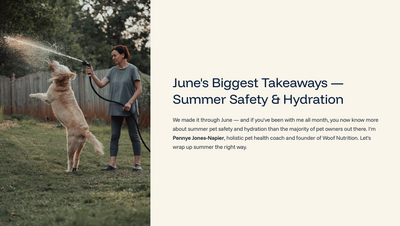
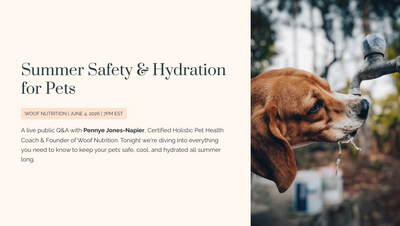
Free Public Live Q&A — Summer Safety & Hydration Thursday, June 4 | 7PM EST
Core focus: keeping dogs and cats safe during summer heat through heat stroke prevention, strategic hydration, diet adjustments, and environmental awareness, framed within both practical pet care and Traditional Chinese Veterinary Medicine (TCVM) principles
Secondary topics: coprophagia (stool eating) and polyuria in a shelter beagle; senior cat with hyperthyroidism; breed-specific risk factors for heat sensitivity; and practical guidance for professional dog walkers and pet sitters
What Was Discussed
TCVM Framework for Summer Health
Pennye explained that in TCVM, summer is governed by the heart and fire element, representing peak yang energy 1
This yang dominance can overwhelm yin — the body's cooling and moistening essence — making intentional dietary and environmental cooling critical during this season 1
Dogs cool primarily through panting, which is an inefficient system causing rapid fluid loss; cats are even more heat-sensitive but tend to hide symptoms, making early detection harder 2
High-Risk Populations
Pennye identified the following as highest-risk groups requiring extra vigilance: 2
Flat-faced (brachycephalic) breeds — e.g., bulldogs — due to compromised airway anatomy
Senior animals
Overweight pets
Animals with thick or double coats
Pets with heart or kidney disease (compromised cooling systems)
Pennye shared a real-world example: at Great Falls park, she intervened with a young couple whose bulldog was on the verge of collapse in the heat; she had to claim she was a vet tech to get them to act 3
Robin added that Dalmatians and bulldogs are breeds prone to urinary crystals or stones, making hydration especially critical for them during summer 4
Recognizing Heat Stress vs. Heat Stroke
Heat Stress Signs:
Excessive, sometimes loud panting 5
Increased thirst, drooling
Weakness, lethargy, seeking shade
Skin that is especially warm to the touch (check behind ears, under neck) 5
Immediate response for heat stress:
Move to shade or cool indoor environment
Apply cool (not cold/ice) water or wet towels to neck, armpits, and groin 6
Monitor closely
Heat Stroke Signs (medical emergency): 6
Very rapid, labored panting; difficulty breathing
Vomiting, diarrhea (possibly bloody)
Dizziness, staggering, disorientation
Gums appear bright red or very pale
Elevated heart rate; in severe cases, seizures or loss of consciousness
Response for heat stroke:
Apply lukewarm-to-cool (never ice) wet towels to neck, armpits, paws
Do not use ice — it constricts capillaries and worsens the situation 6
Get to an emergency vet immediately; call en route
Emergency vets may administer cool IV fluids 7
Gum and Skin Assessment Techniques
Pennye walked through two hands-on assessment methods: 8
Gum color and capillary refill: Lift the lip — gums should be bubblegum pink, moist, and slightly slippery; press and color should return within 1–2 seconds; dry/tacky gums = dehydration; bright red or gray/blue with slow refill = emergency 8
Skin tenting: Gently pinch skin at back of neck — should spring back instantly; slow return indicates dehydration, commonly seen in older cats with chronic kidney disease 9
Noah asked for clarification on whether these signs (dry/tacky gums, skin tenting, dark urine) were heat stress or heat stroke indicators — Pennye clarified: dry/tacky gums with good rebound = heat stress/early dehydration; fire-red gums with labored panting and elevated heart rate = heat stroke 1011
Hydration and Diet Strategies
Pennye highlighted the dramatic difference in moisture content across diet types: 712
Dry kibble: only 5–10% moisture — animals must compensate entirely through drinking
Raw or lightly cooked food: 60–75% moisture — built into the meal
Canned/wet food: 75–80% moisture — highest moisture content and most sterile option
A common observation when switching to moisture-rich diets: owners notice pets drink less water — this is normal and expected, as dietary moisture meets a large portion of daily needs 12
Even partial upgrades help: adding bone broth, a wet food topper, or rehydrating kibble can make a meaningful difference 12
Cooling foods recommended by Pennye (TCVM-based): 1314
Dogs: seedless watermelon, cucumber, cantaloupe, celery (also high in fiber), blueberries (antioxidant-rich, actively help clear heat)
Cats (obligate carnivores — focus on cooling proteins):
Duck, rabbit — cooling
Turkey — neutral to slightly cooling
Scale back chicken in summer (warming in TCVM)
Cold-water fish (mackerel, sardines) in moderation
Bone broth and plain unsweetened diluted coconut water (natural electrolytes, cooling in nature) 14
Robin's additions: 41516
Her Dalmatian loves lettuce and mini cucumbers — great hydrating snacks
Soaking kibble in hot water for at least 20 minutes increases moisture; a useful test — kibbles that never soften should be avoided
Uses Beam Minerals electrolyte supplement daily, creating a "hydration bowl" 2–3 times per day with floating additions (blueberries, apple, shredded turkey) 16
Specific Products Mentioned
OC Raw Hydro Life (powdered): mixed into water or bone broth; contains antioxidants and electrolyte support; Pennye's foster dog laps it up 17
Solutions raw goat's milk (fermented): highly bioavailable, gut-supportive, full of probiotics; effective for picky drinkers; any brand of raw goat's milk works 18
Green Juju — Bailey's Blend: whole food topper cooked in bone broth; developed for a dog with cancer; cooling vegetables 18
Green Juju — Just Greens: similar formula to Bailey's Blend with slightly different ingredients 18
Green Juju — BAM's Beets: antioxidant-rich, anti-inflammatory; use in small amounts for dogs (beets are high in natural sugars); very small amounts acceptable for cats 19
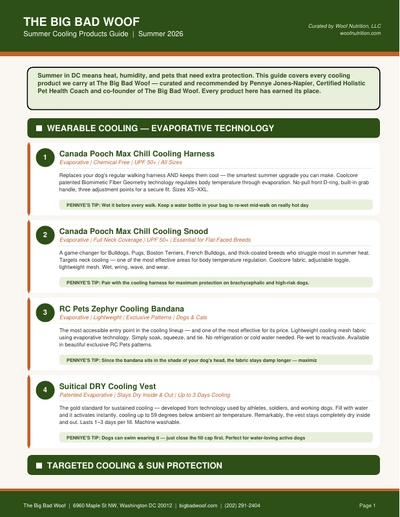
Bay Dog Arctic Bay Cooling Collar: frozen insert packs; must be frozen solid (not just refrigerated); replacement ice packs available for continuous use; available at BayDog.com 20
Canada Pooch Cooling Harness: wet-activated cooling vest harness; regulates body temperature during summer walks 21
RC Pet cooling bandanas / snoods: can be wetted down and placed on the neck during walks 22
High-tech working dog cooling suits (carried at Big Bad Woof): stay cool for up to 3 days when filled with water; designed for fire department dogs, search and rescue, wildfire response 22
Musher's Secret: paw balm to protect pads on hot pavement 23
Dr. Harvey's: rehydrating base diet recommended for the shelter beagle 2425
Pavement Safety
Pavement can be up to 60°F hotter than the surrounding ambient air temperature 23
Test: place your hand flat on the pavement — if you cannot hold it for 5–7 seconds, it is too hot for the dog's paws 23
Use grass where possible; consider dog boots for extended outdoor time in heat 23
Robin echoed frustration seeing people walk dogs on cement and blacktop midday in Arizona: "go walk barefoot on that and see how that feels" 15
Pennye's sister-in-law in Scottsdale: walks dogs only early morning or early evening; if midday, dogs ride in a golf cart 26
Dog Walker and Pet Sitter Guidance (Fetch Pet Care Staff)
Noah (new hire at Fetch) asked about environmental temperature thresholds — Pennye explained that a dog's normal rectal temperature is ~102°F; since walkers can't take each dog's temperature, the practical approach is: 27
Check warmth under armpits, behind ears, inside back leg
If the dog feels significantly warmer than your own ~98°F body temperature, move to shade or a cooler area 28
Fetch policy: in extreme heat or cold, 30-minute walks are shortened to 15 minutes; remaining time spent indoors with games and enrichment 29
During the recent 90–95°F heat wave in the DMV area, Noah kept all walks to ~15 minutes outside 29
Robin referenced a news segment recommending no more than 15–20 minutes outdoors when temperatures hit 90°F or above 30
Pennye's advice for dog walkers: carry small workout towels and a water bottle at all times; wet towels can be applied to the neck, armpits, and paws if a dog overheats away from home 31
Push walk schedules earlier in the morning and later in the evening as much as client schedules allow; when midday walks are unavoidable, seek well-shaded routes 28
Emergency vet number should be saved in every pet caregiver's phone 7
Shelter Beagle — Polyuria and Coprophagia
Susan described a beagle at the shelter: overweight (likely overfed), holding urine in his kennel but producing large volumes of urine when taken out; not a heavy water drinker; lab work pending (thyroid, diabetes ruled out — no sugar in urine) 32
Pennye's assessment:
Currently on kibble (ProPlan or Blue Buffalo) — recommended keeping on Blue Buffalo for better ingredient quality 24
ProPlan contains corn, corn gluten meal, wheat, and salt — ingredients that drive excess thirst and high urine volume 25
Recommended switching to Dr. Harvey's (rehydrating base diet) to reduce processed ingredient load and potentially normalize urine output 25
Adding bone broth to current diet as an interim step 24
Coprophagia (stool eating): Pennye identified two possible causes: 33
Behavioral — almost OCD-like; may respond to a calming supplement
Nutritional deficiency — animal is "starving" nutritionally despite eating; body seeks missing nutrients
Switching to Dr. Harvey's may address the nutritional component; behavioral supplements can be trialed if it persists 33
Senior Cat with Hyperthyroidism
Susan asked on behalf of a friend whose senior cat has thyroid disease; currently on a prescription thyroid diet (kibble) and Smalls (lightly cooked wet food) 3435
Pennye's guidance:
Smalls is a strong choice — gently cooked, moisture-rich, well-suited to the condition 35
Limit fish intake — excessive fish can negatively affect thyroid levels 35
Cat is on no thyroid medication — just diet management; Pennye noted she recently advised a friend in Arkansas whose cat was on thyroid medication, aiming to titrate the medication down through dietary intervention 36
Pennye will review her notes from the Arkansas case and follow up; may involve B vitamins or other supplements 37
Robin reinforced that for cats generally, maximizing wet/canned protein is the most impactful dietary lever 37
Action: Susan to send Pennye an email with full details (current diet, any medications) for a personalized follow-up 36
Search and Rescue / Working Dog Segment
Pennye shared an experience attending a helicopter training session with fire department dogs (mostly Malinois and German Shepherds) 38
Dogs must be harness-attached to their handlers and airlifted by helicopter into areas inaccessible by truck 38
Many search and rescue handlers in the DMV area are women volunteers — not their primary job; they train alongside fire department and rescue teams 38
The high-tech cooling suits (3-day water-activated) were brought into the store specifically for these working dogs in fire/wildfire/SAR environments 39
Takeaway / Understanding
The session delivered a comprehensive, layered framework for summer pet safety, moving from TCVM philosophy through clinical warning signs, dietary intervention, and practical field tools. The consistent theme across all topics — heat management, shelter animal care, and thyroid support — was that moisture-rich, minimally processed nutrition is the first and most impactful line of defense, with environmental awareness and fast recognition of distress signs serving as the critical safety net for pet owners, sitters, and shelter workers alike.
 Please log in or register to post a comment